
T-shirt necklines, underwear waistbands and bedsheet edges often use fabric binding: a long, narrow strip sewn around an edge to finish, reinforce or decorate it. This guide explains its uses, cutting methods and the benefits of a dedicated machine in production.
What is binding used for?
- Edge finishing: Covers cut edges and helps prevent fraying.
- Reinforcement: Strengthens necklines, cuffs and waistbands.
- Appearance: Contrasting colours or patterns provide a decorative border.
Binding is common in cotton knitwear, stretch garments, underwear, baby clothing, home textiles, bags and upholstery.
Manual or machine cutting?
Small quantities can be cut with scissors and a ruler or on a cutting table. For larger volumes, manual cutting can cause inconsistent widths, fabric waste and slower output. Even small width differences affect sewing and appearance. A cutting machine maintains the selected width throughout production.
Open-width fabric: KM 1500
The KM 1500 Automatic Bias Cutting Machine cuts strips from 1 to 10 cm wide.
- Drive system and digital speed display: Choose and monitor a speed suitable for the fabric.
- HSS steel blades: Designed to retain sharpness during intensive production.
- Automatic lubrication: Lubricates the blade mechanism during operation.
- Fabric tension bar: Helps thin and elastic fabrics feed evenly without folding.
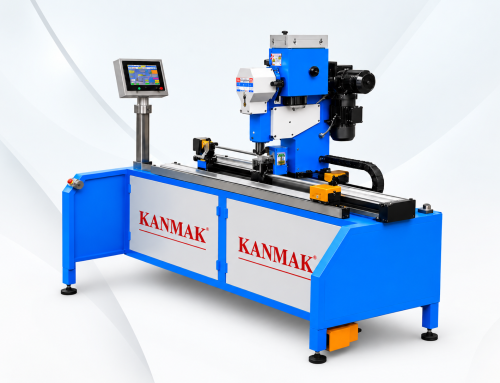
Tubular fabric: KM 1700
Cotton jersey and stretch fabrics often arrive as circular-knitted tubes. The KM 1700 Automatic Tubular Binding Cutting Machine cuts these directly without first opening the fabric.
- Two versions: For tube widths of 45–200 cm and 30–80 cm.
- Multiple blades: A 26 cm steel blade bar cuts three strips as standard and supports up to five blades. Different strip widths can be cut together.
- Automatic winding: Winds to the selected diameter and stops at the target.
- Digital length counter: Displays the output length.
- Compact construction: Occupies approximately 1 m² and has wheels for movement within the workshop.
Which model suits your work?
| Feature | KM 1500 | KM 1700 |
|---|---|---|
| Fabric | Open-width | Tubular |
| Strip width | 1–10 cm | Adjusted by blade position |
| Typical use | Garments and home textiles | Jersey, stretchwear and underwear |
| Winding | — | Automatic, diameter-controlled |
Three tips for efficient cutting
- Use a lower speed for thin or stretchy fabric when needed for a clean cut.
- Inspect blades regularly; blunt blades can cause fraying and uneven widths.
- Cut and measure a sample before starting a long production run.
Contact Kanmak for help selecting a machine for your fabric: [email protected].